Friday, September 05, 2014

Day 58 - Just write

Today, after what felt like a long morning spent with a couple of our instrumental tutors covering a variety of topics, I went home to compose. I spent a fruitful afternoon and came up with a harmonic structure for a new piece with which I was happy.

In my inbox was an email from a fantastic performer, thanking me for an essay I had sent to them detailing some structural analysis of a piece that I wrote around 15 years ago.

I'm happy that I'm writing music, but not happy that I'm not writing words down. I've thought for some time that it was worth going back to essays such as that one, combining it with other things I have noted, and seeing if there isn't a grown up analytical paper there. But I don't.

It's easier to 'know' that you could do something if you put your mind to it, than to put your mind to it and risk failing.

But I'm writing music and trying to switch off from other pressures from work. I definitely feel like I have a way to go when it comes to compartmentalising the different aspects of my job, but at least, for one afternoon, I sat down at manuscript paper and wrote some music that I will hear soon.

And that's a great feeling.

Labels: , , , , , , , ,

Wednesday, August 06, 2014

Day 28 - And sometimes you will have a better idea

Yesterday, I reflected on the problem that I had with a particular concert.
All day today, I've been discussing it with others and turning it over in my mind.
By the end of the day, I had a solution.
And do you know what?
The solution was better than the plan it was replacing.

Rather than holding one concert in October with student work and my own music, on the basis of which a competition would be judged, I'm proposing two events:
  1. A shorter concert of my own music demonstrating the relationship between maths and music in my practice, a 20 minute paper on this connection by me, a similar 20 minute paper from someone from the Mathematics department on the connection that they perceive between composition and maths, and the announcement of the competition;
  2. A concert of specially composed music by current and former students of my institution, culminating in the announcement of the prize.
The idea will be, with the initial concert happening in October, a deadline for submission in December, and a second concert happening in February.

This, to me, gives more scope and possibilities to the whole project, as well as raising the profile and awareness of the whole thing. It is possible that I may be accused of promoting my own work to the detriment of others though, and I'm not sure what to think about that.

Labels: , , , , , ,

Tuesday, August 05, 2014

Day 27 - Idealism, realism, and sheer bloody-mindedism

Sometimes, you commit to something, and you think that you have plenty of time.
And then you realise that you really don't.

You have a few options.
  1. Cancel the project
  2. Postpone the project
  3. Bluff
Now I'm allergic to 1. I just don't like admitting defeat, and I prefer to make sure that the project happens one way or another. My default position tends to be 3, and I have had a lot of success in throwing projects together without sufficient lead-in time or rehearsal. But that only gets you so far, and if you want something to be as good as you imagine it can be, it's a shame to not deliver the project that you could deliver.

I think that a good approach is that if you feel that the project will be substantially better if you have more time, go for a postponement. Most times, it will be your project anyway, and the only person that you're really reporting to is you. Admittedly that can be a pretty scary person to report to, but you get used to it.

If you can see a way to make the project happen anyway, to a standard that you are happy with, then bluff your way through; improvise and make decisions on the hoof. I think that's a really good skill to have as an academic but also as an artist. Life frequently doesn't go to plan, and being able to make adjustments that deliver an uncompromised result without destroying your life will ensure that you can pull almost anything off.

I will also have to learn when it is appropriate to cancel, but I refuse to really engage with that at present.

I'm reflecting on this today, because I've realised that I have to be realistic about a deadline that I have looming. There's a concert coming up for which I have to write a piece (involving software that I don't know), organise performers, organise a competition (complete with panel), and organise some publicity. There is no way it will happen when it is planned to happen in the way that I want it to happen. I'm pretty sure I can finish a piece with which I'll be happy by the end of this month, and I'll be able to find people to play it, but getting others to write to the same schedule, finding players, organising a rehearsal schedule, and organising, advertising, and administering a competition is most likely beyond me.

So tomorrow I have to write a difficult email, because I have already postponed this concert once. I have to ask if we can hold it later in the year (but it has to be this year because of annoying things like the specific anniversary that this marks). I dislike having to show weakness in this way, but I also intend to send a plan of campaign with a schedule and timings for all the constituent elements that have to occur. This is useful for me, obviously, but also lets the other people involved know that I'm not going to let this happen again.

If another postponement isn't possible, I'm not sure what I will do. I'll have to improvise. As usual.

Labels: , , , , , , ,

Friday, July 25, 2014

Day 18 - Research lifecycles

Every story has a beginning, a middle, and an end.
Actually I don't believe that.
Actually I do, sort of. In that by the time that you've listened to the story, the way that you remember it, irrespective of how it has been told, is as having a beginning, a middle, and an end. I think it's how our brains are wired up, or how we are culturally programmed to remember our experiences of the world.

So, every story has a beginning, a middle, and an end.
Every research project similarly has a beginning, a middle, and an end.
You may feel like you didn't know that the beginning was truly the beginning until you were in the middle of the middle (or the middle of the end), but in retrospect, you can begin to diagnose what happened.

Something that I have noticed happen within my own practice a lot as a creative researcher, is that I tend to view my compositional activities as a block - I am composing, and it doesn't matter what I am composing - rather than as individual projects. This is something which I am beginning to recognise could change, and could change things within what I do for the better.

Just as I have a sort of plan in my head for how my articles and my book proposal pan out over the next few years, I am beginning to scramble together ideas for my compositional projects. So rather than just thinking about writing, I'm thinking about the entire life-cycle of the process. This includes the conception of the piece and the initial research to develop a methodology, contacting performers who may be interested in playing it, or in collaborating, carrying out the methodology, and then editing the notation, and producing a final score (if applicable). Of course, then the interesting stuff begins as you can incorporate the performance into your research process, especially if the performer(s) is/are going to do it more than once. Is the 'new knowledge' that you have 'effectively shared' through the medium of a score artefact and a live performance artefact appropriate for another medium, for example an article?

In this way, I am hoping to transform my experience of plugging away at composition, enlivened by the occasional performance, into something a bit more dynamic. It may sound a little corporate, but I think that it is what I need (and connects to what I was talking about yesterday). I'm also slightly interested in looking at this from the angle of the Research Development Framework which my institution has adopted. I'd be very interested to see any comments from anyone who has experience of this framework.

Every story has a beginning, a middle, or an end, but a story is always a tracing, not a map. It doesn't describe the larger narrative of your compositional/musicological/performative trajectory, with its many interpenetrating variables, but it's a useful way of organising what you do in a way that can fit into a workload allocation, and in a way that is in a language that any academic should be able to recognise, no matter what their discipline.

Labels: , , , , , , ,

Thursday, July 24, 2014

Day 17 - What I Did On My Holiday

When I was 19, I wanted to be a composer. From a series of childhood ideas (author, pianist, librarian, archaeologist), this one had survived.
I was at the end of the first year of undergraduate study, and had a good idea about what sort of music I wanted to spend my life writing.
I had just finished a string quartet. It was 20 minutes long, written for four performers with click-tracks, each playing part of a texture which expanded out from a central Bb to the extremes of their registers, and rhythmically derived from six possible metrical layers, each related in tempo 2:3 (hence the click tracks). Single-(bloody)-minded, and destined to be unpopular.

I looked at this piece, and I knew that it was probably never going to be considered as entertaining or get me a gig as a film composer. And I didn't care. This was the kind of music I wanted to write for the rest of my life.

Crap.

So what kind of career could I pursue? I had been reading plenty of interviews with composers that year, and it had taught me one thing about contemporary composition: if you wanted to write unpopular bloody-minded music, one of the safest career choices is academia. And so, that was that.

I did not get into teaching because I loved teaching. I got into teaching because I wanted to write music without worrying about what people thought of it. Luckily, I love teaching and I seem to have a knack for it, and it has taken over my life in ways that I never thought possible. My research now grows out of my teaching, and my research informs my teaching.

So why am I telling this story today?
I'm spending this holiday (apart from moving flat) writing music, and writing a book proposal. In short, I am carrying out the research part of my job. I am doing this because I love it. That is the true reason underneath it all.
I am lucky enough to have a job that I love, that gives me a real sense of fulfillment every day (well... nearly every day), and a job in which, in theory at least, I should be able to write music and teach alongside each other.
Except, that I am not the only person who gets to choose how I spend my time.
I have a line manager, who is supposed to allocate how my work load is divided, and he approves (or not) research time. At present, we are being told that unfunded research will not be approved, and that we have to carry it out in our own time. While this is completely against the current University strategy, I understand why he is saying it, and it's due to a stupid bureaucratic situation regarding research time that the School has got itself in, that is too stupid and boring to talk about.
But it means that I don't really have the allocation of time to find funding for the projects that I want to do.

So how do you follow your own ideas about research when your Institution (or at least the manifestations of the Institution's authority) has other ideas?

The only answer I have to give, is that you invest your own time (and money if necessary) to get projects off the ground. Nobody is going to drop some money in your lap and tell you to get on with it; you're going to have to fight for the right to write (or play, or whatever).
If you can demonstrate that you've got a project that will lead to an output of international standing, or that you have got funding that will make it happen, or whatever criteria will impress within your field, then, generally speaking, unless they are complete douche-canoes, they will get right on board and claim that they have been in your corner all the time.
This is annoying, and will make you want to get violent (Pro tip: Get a voodoo doll. It's more fun).
But you will have got where you wanted to get.

At the end of the day, you're doing this because you love it and you believe in it.
What is pretty awesome about academia, is that if you can demonstrate that people are willing to invest in your idea, you will get paid to do it.

Labels: , , , , , , ,

Sunday, July 20, 2014

Day 12 - An investment of time

I'm writing this late.
I have in front of my a page of chords, and, open on my computer, a spreadsheet of times that these chords come in a piece.
I am trying to make them marry up.
They are not playing ball.
So I'm going to leave them to it and come back tomorrow.

I could have probably sat down at a desk and done all of this manually, with a series of durations (worked out on the spreadsheet and then printed out), and a series of chords, written out manually. Instead, I have chosen to use OpenMusic.
If I had done this manually, I would have probably finished the piece about six months ago.
But then again, I don't think I would. It's a rather boring task, and not a very fulfilling one, and by working with this software, I'm trying to find ways of working that are more efficient, and that keep me interested. A long time ago (2005?), Richard Barrett advised me to be much more pragmatic about how I work, and although, at the time, I didn't know what he was talking about really, it's become more evident to me, now that my composition time is packaged into small chunks when I'm trying to avoid the housework, how relevant and urgent this advice has become.

So I come back to this fact that I'm slaving away spending so much time messing around with the software trying to make it do what I want it to do, and, in effect, I'm not at all being pragmatic with my time.
But here's the thing.
I intend to use OpenMusic a lot in the future, and to use MIDI to input a lot more raw pitch material, and an investment of time now should make things easier in the future.

This is true, I think, of a lot of things.
Sometimes we just have to bite the bullet and get down to really getting under the skin of a new strand of research or teaching, a new piece of software or technology, or whatever, despite the fact that it seems to be a waste of time.
At our recent Faculty Research Conference, one of the nuggets of advice I offered up to soon-to-be-graduating PhD students was that you have to be willing to invest some of your own time and energy (and sometimes money) into your research in order to make the headway that will convince anyone else to believe in it.
This is quite important I think.
I've said before that this is not a job like most others, and the research angle is certainly not.

Labels: , , , , , , ,

Sunday, March 02, 2014

Irrational harmonies

I've been asked to put together a concert to mark the 400th anniversary of the publication of John Napier's Mirifici Logarithmorum Canonis Descriptio. My institution is named after John Napier, and the campus in which I teach is built around his birthplace. The Mirifici Logarithmorum Canonis Descriptio contains extensive material on natural logarithms, and I decided that this is going to be the theme of this concert.

For my own contribution, I decided to use natural logarithms of integers as frequency multipliers in a similar way that integers are employed in the harmonic series. This is similar to my practice in other works such as for three (which is still in progress) which are constructed from integer ratios.

This is the first time that I have used irrational numbers in ratios rather than integers and it has been an interesting experience.

I started off by taking a fixed equally tempered pitch as a starting point (I started off with B at the centre of the treble staff - around 494 Hertz) and then used log 2, log 3, log 4, log 5, etc. as multipliers of this base frequency.
This results in:
I've used the term 'otonal' here, borrowed from Partch's definitions, to contrast with the 'utonal' structure below, where I have used the inverse of the same natural logs as above as multipliers (or, if you prefer, I have divided the starting pitch by each natural log in succession).
This results in:

In each case I have rounded the deviation in cents from the equally tempered pitch to the nearest 5 cents. This has some implications, which I will discuss in a later post.

What is immediately interesting to me is that, as one would expect, there are octave doublings between the 2nd, 4th, and 16th natural log 'harmonics' (i.e. 2^1, 2^2, 2^3), and between the 3rd and 9th natural log 'harmonics' (i.e. 3^1, 3^2) [NB the exact octave doublings are blurred by rounding to the nearest frequency integer, although it should be noted that the deviation between the actual octave and the specified octave is so small that although it creates beats and is therefore an audible discrepancy, it is likely that the performer will correct for this instinctively given the way in which each pitch is created. This will be discussed further in a later post].

There are also octave equivalences between the frequency n(log 5) and n/(log 12), and the inverse n(log 12) and n/(log5), which create a bridge between the otonal and utonal structures.

The next stage is to test the performance possibilities of the exact frequencies notated. As noted above, this builds on work already carried out on for three, although problems with the first performance of the work have meant that these ideas have never been tested 'in the field'.

I need to establish if
a) I can distinguish gradations of pitch as small as 5 cents;
b) a performer might reasonably be expected to tune to as fine a standard as 5 cents.

Once this is established, I will be able to continue the pre-compositional working. Rounding to the nearest 10 cents will change things a little, although it won't be the end of the world!


Labels: , ,

Thursday, December 29, 2011

for three (score excerpt)

I have written the first three minutes or so of for three.
I'm not totally happy with it, but this gives a flavour (click on the image for a larger version):

Photobucket

Notation:
Multipliers above a rest indicate that the performer should multiply that rest by that number (e.g. if a semibreve rest has a 'x 4' indicator above it, this indicates that there should be four semibreve rests).
A '+' or '-' indicator above a note indicates that pitch should be sharper or flatter (respectively) by this many cents.
At the moment, all dynamics are balanced and as quiet as possible.

About the piece:
I may reduce the speed to something more like crotchet=52 (or slower) and I'm not quite sure how I feel about the nature of these awkward durations. This may be revisited. There may also (when I complete the piece) be alterations to durations etc. down to the progression of this section from these isolated utterances to the smooth overlapping texture.

The name Petrus Abaelardus and the title of his work which includes his allegedly heretical teachings on the doctrine of the trinity, Theologia Summi Boni, have been used to structure the durations of the work. I've always been interested in Abelard. Initially, his relationship with Héloïse was what grabbed me, but as I found out more, his relationship with his son and with Bernard de Clairvaux struck me as interesting. I've been thinking for a while that I'd like to do a series of music theatre clusters around a series of figures, and had thought that they would coincide with decades in my life (An Evening with Ezra Pound was supposed to mark my 30th birthday (3 years ago), and An Evening with Peter Abelard was going to mark my 40th birthday)*. I don't really know how I feel about all of that now but I do think that there may be a cluster of pieces around Abelard and I suppose this may as well be a start. The connection came simply because of the title and the indeterminate instrumentation as related to his theoretical writings on the Trinity, which got him into such hot water with Bernard de Clairvaux.

It's beginning to get to the point that, in order for this project to have a place in my research hours, I'm going to have to come up with a performance. If I don't, then I'll carry on in my spare time, but I'll have to prioritise other projects. Sad but true.

*The final Evening with was going to be Alan Turing. We shall see.

Labels: , ,

Tuesday, December 27, 2011

measuring rests (for three)

I'm trying to work out how to structure the rhythmic shape of the piece (for three).
There are going to be a lot of rests, and I'm not sure how to measure them.
I have basically three ideas:
  1. To use standard rhythmic notation;
  2. To use minutes and seconds to mark the rests (but probably use standard rhythmic notation while they're playing);
  3. To use breaths as a durational method for rests, and for the playing durations.
Idea 3. is very attractive to me, but I don't think it's for this piece. I'm thinking I want to use this in another piece. Maybe more on that later.

I think that each of these three methods of notating rests will create a marked difference for both performers and for audience. I would like to see some research on this (or I suppose I could actually research this myself I suppose). I've written pieces that use the first two methods of measuring rests and performed pieces that use all three, and I certainly feel that the experience is different.
Counting the rests creates (for me as a performer) a sense of very measured time.
Counting minutes and seconds normally involves watching a stopwatch - I would say that 'musical time' freezes and this correspondingly creates more of a sense of stasis for the audience as well.
Having the rests measured by somatic measurements creates a more intimate experience (at least as a performer - I haven't knowingly experienced this as an audience member) and I believe that this experience will be carried through to the audience.

But I don't want to do this for this piece.

Further refinement to the structure of the piece
There are three 'states' of operation:
  1. Long measured silences frame statements of the three pitches (with various tunings)
  2. Very few silences as the three instruments make up a 'tapestry' of sound from the three pitches
  3. Long measured sustained single tones (staggered between the three instruments) frame statements of the three pitches
Rather than these being three different sections of the piece, I'm going to construct the whole piece in two parts. For the first part, I will structure rhythms it in two ways, using both methods 1. and 2. The finished version will progressively move from method 1. to method 2. The second half will use methods 2. and 3. in a corresponding way. This way, there are no clearly defined sections, but each moment of the piece should lead smoothly to the next.

In terms of pitch organisation, I'm hoping to have initial sketch material of the first section ready sometime tomorrow. I think that it's going to stay pretty restricted for the majority of the first section, and then start to move up and around in the second section before stabilising close to the end (although the whole range of the piece is going to be strictly within an octave - when you're exploring an expanded set of proportional tuning ratios, you don't have to gild the lily - which also serves the indeterminate instrumentation).

Labels: , ,

Monday, December 26, 2011

intervallic content (for three)

Just done some quick analysis of the intervallic content of for three.
I've got seven different tunings for the chord (treating the two ratios given here as sort of interval vectors):
  1. 8:9 +15:16
  2. 8:9 + 24:25
  3. 9:10 + 15:16
  4. 9:10 + 128:135
  5. 225:256 + 24:25
  6. 9:10 + 25:27
  7. 225:256 + 128:135
    This gives three major seconds:
    • 9:10 (1.11111111)
    • 8:9 (1.125)
    • 225:256 (1.13777778)
    four minor seconds:
    • 24:25 (1.04166667)
    • 128:135 (1.0546875)
    • 15:16 (1.06666667)
    • 25:27 (1.08)
    and three minor thirds:
    • 64:75 (1.171875)
    • 27:32 (1.18518519)
    • 5:6 (1.2)
    Great so far. Now I need to work out how I'm going to use this in the piece's structure.
    Am I going to go through them in 'keyboard' order (ABCDAAEFBACG), or come up with a new structure based on (what I think are) interesting movements from relative consonance to dissonance and back?
    I'm in two minds.
    I also have to decide which pitch stays constant between each section (this itself could answer the question of 'material' above). I don't want it to be the same pitch, but at the same time (at least) one pitch must stay constant.
    There will also be the question of overall duration, and the proportion of silence and sound.
    At the start, I want there to be silence separating instances of the three players each playing one sustained note. In the middle I want there to be very few breaks in the corporate sonority, with tunings overlapping. At the end, a return to the texture of the beginning. Possibly.
    Overall duration could be as long as 40 minutes, but I don't know if that's crazy. I suppose it depends on the players and on how many sections and how long each section is.
    Enjoying thinking about this. Quite like the idea that the timbre of each performance could be radically different.

    Labels: , ,

    for three

    An idea for a piece:
    Three notes - tone + semitone between them - played by three instruments.
    Use whole number ratios to generate precise tunings (see below) but render these in cents, so that performers, using digital tuners, can tune their individual notes (seated as far apart as necessary to get a 'clean' reading on the tuner).
    The tunings are based on segments of a justly-tuned twelve-tone scale.
    The basis of this scale is that (identified by La Monte Young in his Selected Writings (Heiner Friedrich, 1969. 37-8)) of a diatonic major scale:
    24:27:30:32:36:40:45:48
    In this scale, do:re:mi are in the expected 8:9:10 ratio; both do:so, and fa:do are in a 2:3 ratio; fa:so:la repeat the 8:9:10 ratios of do:re:mi; and te:do repeats the 15:16 ratio of mi:fa.
    There are plenty of pleasant symmetries and repetitions here to satisfy (at least my) aesthetic desires.
    In order to generate the other notes of the fabric, I took utonal relationships based on do, fa and so to create mi flat (5:6 above do), la flat (5:6 above fa) and te flat (5:6 above so). This creates possibilities for just chords based on la flat and on mi flat (both 4:5:6). By the same logic, I calculated re flat from a ratio of 4:5 with fa (just chord re flat:fa:la flat - 4:5:6). This only left me with a so flat/fa sharp to calculate, and I did this by replicating the ratio between la flat and te (64:75), which also gives a 15:16 ratio between fa sharp and so (as you would expect, given that te:do is also 15:16).
    Final ratios of all twelve tones are (in integer ratios):
    480 : 512 : 540 : 576 : 600 : 640 : 675 : 720 : 768 : 800 : 864 : 900 : 960

    Whoopee. Good for me.
    Why do I want to turn this into a piece?
    I like the idea that these three notes can appear in different rhythmic configurations (like in late Feldman, a persistent and fruitful inspiration) and also in different tonal (here, I mean tonal as in proportional) configurations. When studying temperament, the characters of individual keys in temperaments such as well temperament are emphasised, and the idea of presenting a sample of a tuning like this in close-up, so that you're almost sitting in these two proportions for a period of time, is (for me at least) rather an attractive endeavour.

    The instrumentation (and octave displacement) is variable (although all instruments must be at the same octave displacement). I haven't decided how dynamics are going to work, but I suspect they will either be equally balanced and as quiet as possible (whilst maintaining stability of tone), or there will be different dynamic configurations as well (within a pppp, ppp, pp, p band).

    The title is currently for three.
    If anyone is interested, do drop me a line. I am 100% more likely to finish it if someone wants to play it.

    Labels: , ,

    Saturday, May 28, 2011

    Birthday

    Today I turn 33, which seems weird.
    I do feel that the music I'm writing now (well not right now) is good, worth writing, worth playing and worth hearing. I can now look back at my frighteningly (to me at least) prolific years of study as an apprenticeship. There's not all that much that I am bothered to preserve if I am honest, and I've finally (hallelujah!) learnt that there is much to be said for moving on with new projects rather than revisiting old ones.
    Moving away from what you might call complexity towards the (just as complex in other ways) pragmatic notation I've been working on for the last three years, has also had the added advantage that I can play my own music again (theoretically). I'll be doing this at Whitespace in Edinburgh from 5th-19th August this year as part of my exhibition Memories of You, and this has to be good. I'm involved in a very basic way with the things that make up a life in music.
    So I want to carry on writing as much as possible, working with musicians, performing my own music as much as possible, and staying positive. If the music I am writing isn't right, I want to find the music that is right.

    Labels: ,

    Tuesday, May 24, 2011

    Things to come

    Finally finished all of the marking that needed doing...
    Finishing off some orchestration (for secondary school orchestra - more details to follow)
    Once that's done, it's on with the fun.
    As well as everything that I've mentioned above, the summer will see a week or so devoted to getting a good recording by Nicholas Ashton of EMG (stands for 'Even More Geese'), and a session experimenting with the department's 5-octave marimba (and possibly playing with other percussion instruments - timpani and detuned vibraphones (based on some exciting ideas tweeted by Jacob Sudol (@jdsudol on Twitter)).

    While I was taking my MA at Huddersfield, I wrote a piece called More Geese for the Firebird ensemble conducted by Barrie Webb with Alison Wells singing mezzo-soprano. The piece was based on Orlando Gibbon's madrigal The Silver Swan but extrapolated from the original material and really problematised the rhythmic structure. Even though I loved the piece, and the players and Alison did a great job, the notation made the whole piece a lot harder than it should have been. Although, at the time, what I was aiming for was a sense of rhythmic floating, almost like a tightrope walk, my obsession with ideas of control were getting in the way of what I actually wanted to hear (at least that's my perspective now). I had written the piece in reaction to an editorial by Steve Martland for spnm's in-house magazine new notes (spnm has now merged with other UK concerns to become Sound and Music) in which he said that 'notation is merely a means to an end'. I still feel that as a sound-bite, that really misses the point about notation and its relationship to its realisation, and that notation has its own implied (unwritten) tradition, simply based on a reception and interpretative tradition so by writing in a certain way (as I was then), I was aligning myself with composers like Brian Ferneyhough and Michael Finnissy rather than with composers like Steve Reich or Peter Maxwell Davies (to pick two names out of the air). In many ways though, my piece missed the point. So much attention rested on the notation and its realisation (and the relationship of the parts to the conductor's pulse) that the 'history' of the notation became more important than the way it sounded (so far so good) but only to the performers. The sound was rather beautiful and floating, but it didn't rely on the notation to make it like this. So I want to revisit the notation and make it less rhythmically problematic, and dispose of the conductor and the score. I'm convinced that the piece will be stronger for it.

    Even More Geese is a piece for solo piano that I haven't finished. It exists in potential but not in reality. the idea is that I will take the uncoordinated parts of More Geese and transcribe them for solo piano. The notational aspect of this is going to take a lot of thinking about, but I think it could be a good piece... We shall see if I ever get around to writing it of course!

    EMG takes a series of vertical slices from the potential score of Even More Geese and sustains them as chords for a specified length of time based on a durational series. This durational series, and the (related) series that determined from where (or rather when) these slices were to be taken were derived from the name of the dedicatee (Nicholas Ashton) . I'm still in the process of inputting this into Sibelius and making the notation all 'nice' from my hand-scrawled (my carefully hand-written scores of the past are now, alas, in the past) A3 manuscript (it's a bit more than making it neat though - I want to clean up the score and remove some of the stave lines to give more of a sense of the sound of the piece from the notation), but at present it looks a little like this (click for a bigger copy): Photobucket 
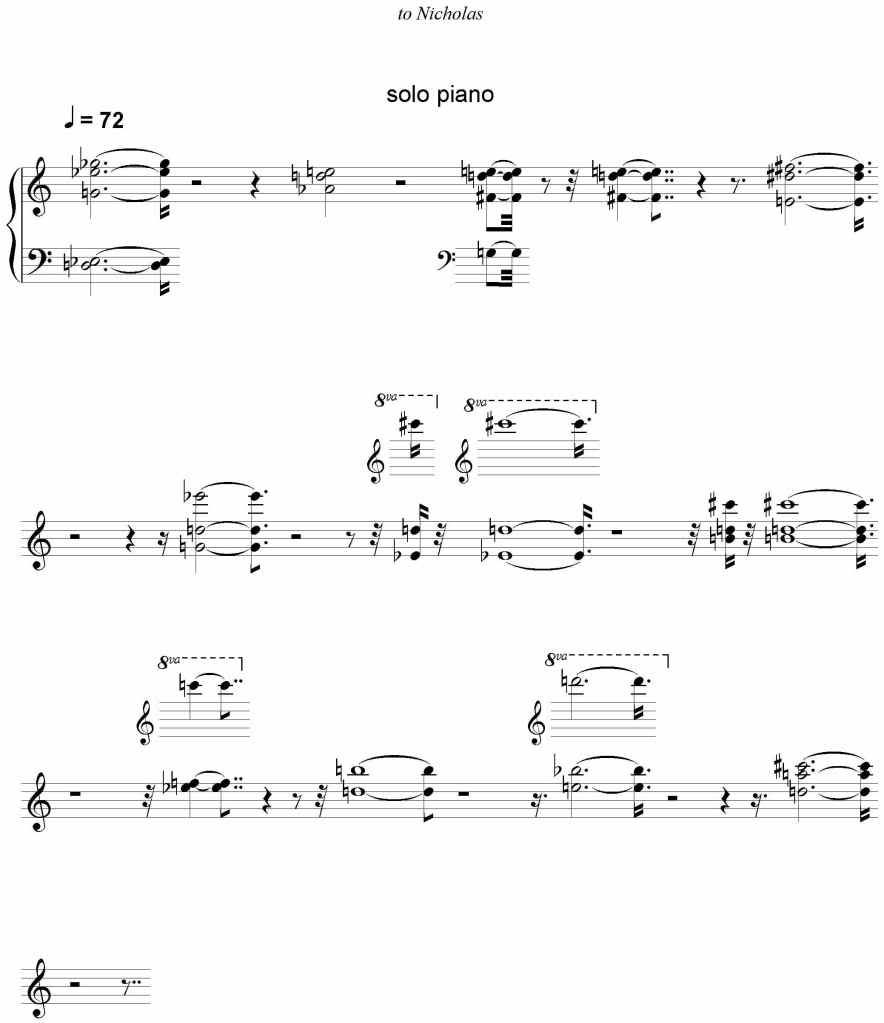
    I say 'a little like this' because there are some revisions still to be implemented but hopefully you get the idea. Chains of (metreless) durations are what concern me at the moment, and I would say that they dominate much of what I am writing at the moment.

    The experiments in percussion are for a couple of reasons really. The first is to pick the brains of the percussionist from my ensemble, Edinburgh Experimental Musicians, Ian Munro, before he leaves for his MA place in London next year, but the second is for a specific piece. I originally wrote the instrumental parts of JAMESTENNEY for [rout] and scored it for soprano saxophone, electric violin, electric guitar, bass guitar, piano, hammond organ, and sine waves. Never quite got around to finishing the instrumental parts, but the notation was beginning to move away from the complex rhythmic notation that dominated my PhD writing, and towards the more simplified (indeed inspired, in part, by the composers of the so-called Cologne School) notation that I'm trying to get to right now. I would say that the reason I didn't finish it was because the notation (and the compositional approach) was still in embryonic form. I didn't know what I was doing. The sine wave part was finished (and can be heard by visiting my myspace page) and I'm hoping to finish a solo piano version in time to play it at the Edinburgh Festival Fringe this summer, but I'm revisiting the original instrumental parts. My plan is to replace the piano part with an amplified marimba. Why do I want to do this? In part, it's a practical thing: in order to perform a part with a piano, you have to have a venue with a piano, and a marimba (even a 5-octave marimba) is just easier to transport; but I also want to explore what you can do with an amplified marimba. I've always written the marimba off so I want to see if I can make something of it... Only time will tell I guess. Quite enjoy this sense of moving away from the traditional 'nailed down' concept of what does and doesn't constitute a 'work' and I think that the instrumental parts may well be a compendium from which performers can select an ensemble (rather like Cage's Concert - a work that is informing ideas about Kinderszenen as well).

    In many ways this is all very 'me me me' (and some would say that's how I've always been). Will perhaps say some things about composers that I think are worth listening to over the next few weeks. Then again, I may just witter on about me and the pieces I'm just about to write any day now as soon as other things cease being quite so important...

    Labels: , , , ,